Contact Us

Our Projects/Industrial & Consumer/Schneider Electric

Industrial & Consumer

Turning process waste heat into a pathway to electrification.

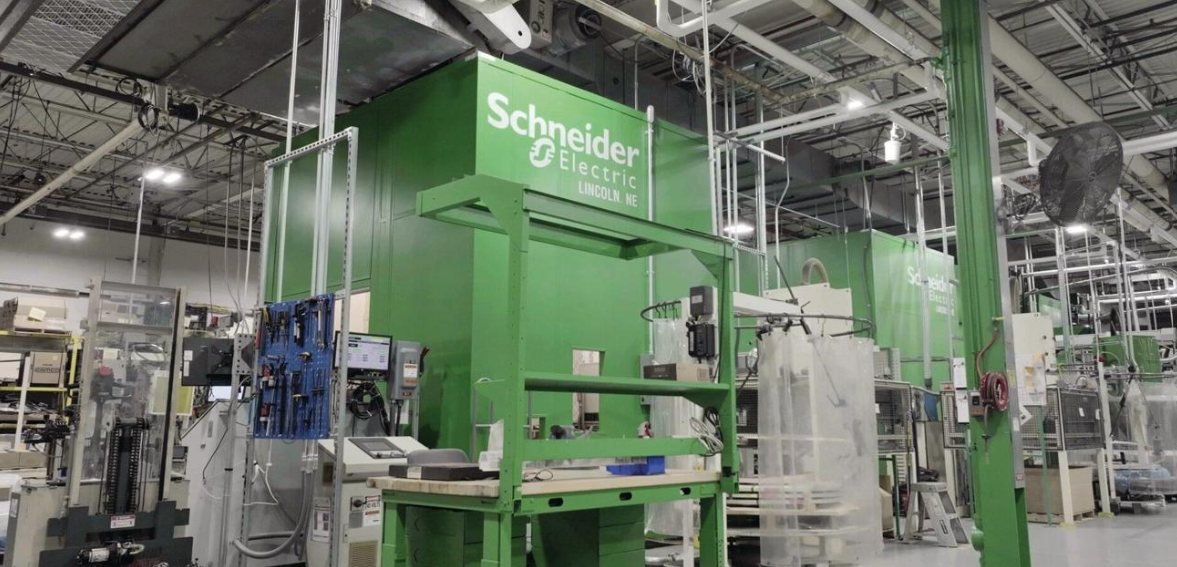
At Schneider Electric’s Lincoln, Nebraska manufacturing plant, WEI developed a multi-phase strategy that first recovers low-temperature process heat for building heating and now advances the facility toward geothermal-based electrification.

Key Results

Key results

1.5–2.3 MMBtu/h
Observed Phase 1 process-heat recovery
900 tons
Phase 2 chiller capacity in current design
2 phases
Heat recovery → geothermal electrification
1 The Challenge

Rethinking heating and cooling as one thermal system

The Lincoln plant historically used natural-gas-fired steam for heating while separate chilled-water and process-cooling systems rejected usable heat. Schneider’s electrification goals created a chance to connect those systems and cut steam reliance without disrupting manufacturing.

2 WEI’s Approach

Start with the heat already inside the plant

WEI’s feasibility study evaluated the plant’s utilities, HVAC, steam, process cooling, controls and thermal loads. Preliminary engineering found the process-cooling water was warm enough in winter to serve as a direct low-temperature heating source.

That simplified Phase 1: rather than adding heat-pump equipment immediately, WEI reused the existing hydronic distribution and HVAC coils so the same infrastructure delivers chilled water in summer and recovered hot water in winter.

Phase 1 · Completed

Low-temperature process heat recovery + positive-pressure HVAC control

Completed in 2024, Phase 1 tied the process-cooling loop into the building hydronic system, expanded sensing and BMS controls, and used recovered heat as the primary winter source, with steam retained as backup.

3 Measured Performance

Use operating data to design the next phase

Monitoring through the 2024–2025 heating season showed approximately 1.5 to 2.3 MMBtu/h of recoverable process heat. WEI used that measured performance, together with updated heating and cooling loads, to refine the geothermal system rather than relying only on pre-construction assumptions.

4 Phase 2

Building on heat recovery with geothermal electrification

Phase 2 is now under implementation. The current design adds a geothermal field and two 450-ton water-cooled chillers that can provide conventional cooling in summer and heat-pump operation in winter.

The design keeps process heat recovery as the first source of winter heat, with geothermal supplying the rest. Existing hydronic infrastructure is reused where practical, while major steam-heating equipment is removed as the plant moves to hot-water heating.

Phase 2 figures reflect the current design and work in progress — not verified completed performance.

Integrated Thermal Strategy

One coordinated system

Process heat recovery, geothermal energy, heat-pump chillers and existing cooling infrastructure are coordinated as one system.

From Engineering to Operation

Through verification

WEI’s role continues through implementation coordination, field issue resolution, CTS, commissioning, training and M&V.

5 WEI Services

One team from feasibility through verification

Feasibility Study & Energy Modeling
Preliminary Engineering
Mechanical & Controls Design Development
Implementation & Contractor Coordination
Check / Test / Start (CTS)
Commissioning & Training
Monitoring & Verification

ENGINEERED. INSTALLED. VERIFIED.

Decarbonization works best when the system is engineered as a whole.

WEI develops solutions from facility analysis through implementation, commissioning and long-term performance verification.

Start a Conversation → Back to Industrial & Consumer